Designing an Integrated
eSIM Experience in GoPay
As technology continues to evolve, new innovations are reshaping how people stay connected, one of which is eSIM (digital SIM cards).
IAK, as an eSIM provider, partnered with Gopay to enable users to seamlessly purchase and activate eSIMs directly within the Gopay app, especially for international travel use cases.
Design an in-app eSIM experience within the Gopay ecosystem, ensuring the entire journey, from discovery to activation felt intuitive, fast, and native to Gopay.
⊹End-to-end UX/UI design for eSIM integration in Gopay
⊹Rapid research, IA, wireframing, and hi-fi UI under tight deadlines
⊹Design system alignment and cross-team collaboration
2 month
released
+35%
user engagement
80%
user completion
Discover
Due to the limited one-month timeline, the discovery phase was highly focused and prioritized efficiency.
Stakeholder discussions with the IAK product and business teams to understand technical constraints, business goals, and success metrics
Competitive benchmarking of existing eSIM products and travel connectivity solutions to identify common patterns, friction points, and best practices
Flow analysis of the Gopay app, studying how users discover new features, complete purchases, and activate services within the app
From this phase, we identified key insights:
Users prefer quick access and minimal decision-making
Trust and clarity are critical when introducing a new digital product inside a financial app
The activation process must feel guided and fail-safe, as eSIM is unfamiliar to many users
Define
In this phase, we focused on aligning our solution with Gopay’s design principles.

Collected and analyzed Gopay’s visual system, including corner radius, spacing, typography, color usage, and component behavior
Studied existing Gopay user flows to understand how consistency is maintained across different features
Defined core UX principles for the eSIM experience, such as clarity, minimal steps, and reassurance
These findings became the foundation for adapting our eSIM design system to feel native and consistent with Gopay’s interface.
Develop
We started by creating an Information Architecture (IA) diagram to map the simplest and clearest user flow for eSIM discovery, purchase, and activation.
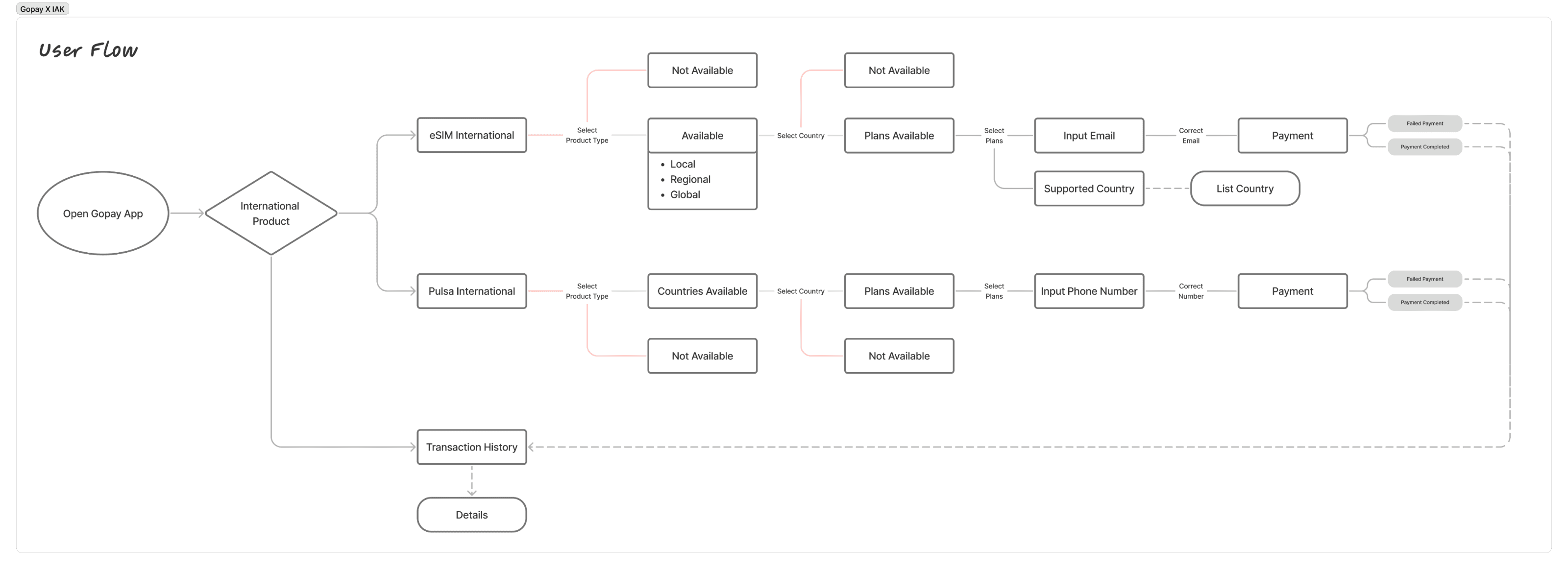
Designing low-fidelity wireframes to explore layout and flow options
Iterating based on internal feedback and technical considerations
Moving into high-fidelity designs once the flow was validated
After finalizing the hi-fi designs, we prepared:
Design Assets

Interaction details

Handover
Deliver
This collaborative iteration ensured the solution was validated, feasible, and aligned with Gopay’s standards before moving into development.
Walk through design decisions
Address feedback and technical concerns
Refine flows and UI details based on their review